← Home · Excavations

Soft Ground Tunnel Analysis in Murfreesboro: Geotechnical Strategy for Weak Formations

Together, we solve the challenges of tomorrow.

EXPLORE →

The contrast between Murfreesboro's historic downtown, built on relatively stable limestone bedrock near the Stones River, and the expanding development corridors along I-24 toward the Blackman community couldn't be starker when planning underground infrastructure. The latter often encounters thick sequences of alluvial clay and residual soil overburden that can exceed 40 feet in depth before reaching competent rock. Geotechnical analysis for soft soil tunnels here requires a focused assessment of low undrained shear strength materials that deform under minimal face pressure. Our team combines subsurface exploration with laboratory strength testing to characterize these weak zones before any tunneling shield ever breaks ground. Where the overburden transitions from stiff clay to loose granular layers, we integrate findings from both CPT testing and SPT drilling to define the soil profile with the precision demanded by sequential excavation methods.

In Murfreesboro's deep alluvial clays, stand-up time isn't a textbook value—it's a function of accurate undrained shear strength and face pressure management.

Scope of work

IBC Chapter 18 and ASTM D2487 classification standards form the backbone of every soft ground tunnel investigation we perform in Rutherford County, but the local geology demands supplementary protocols. The dark gray, high-plasticity clays common in the Murfreesboro area—often classified as CH under the Unified Soil Classification System—exhibit shrink-swell behavior and can lose significant strength when exposed to construction water. Our laboratory program quantifies this sensitivity through unconsolidated-undrained triaxial compression and Atterberg limits testing. For tunnels advancing below the water table, where the alluvium contains interbedded silt lenses, we deploy in-situ permeability testing to measure hydraulic conductivity directly, providing the design team with realistic inflow estimates. When the alignment crosses near active karst features, a condition not unusual in Middle Tennessee, the ground investigation expands to include resistivity surveys that map voids and solution channels which could compromise tunnel crown stability or cause sudden loss of face support.
Soft Ground Tunnel Analysis in Murfreesboro: Geotechnical Strategy for Weak Formations
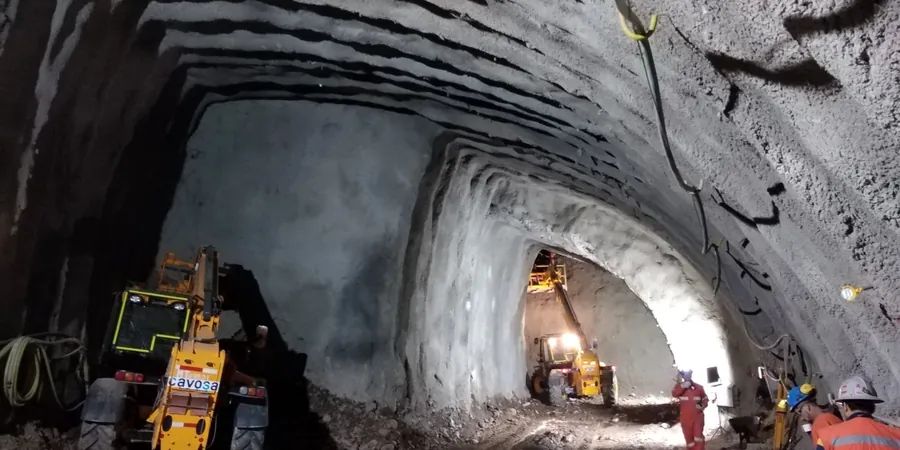
Technical reference image — Murfreesboro

Area-specific notes

One thing we consistently observe in Murfreesboro is that the most significant risk in soft ground tunneling isn't always the soil itself—it's the groundwater interaction with residual clay seams above pinnacled limestone. In these transition zones, a tunnel face can pass from stiff material into a water-bearing, softened clay pocket within a few linear feet, leading to rapid face instability if not anticipated. A purely empirical approach based on average SPT values often misses these localized weak spots. Our ground characterization focuses on identifying these contacts through continuous sampling and piezometric monitoring. For tunnels proposed near the West Fork Stones River floodplain, the potential for liquefaction of shallow sand lenses under seismic loading must also be evaluated, even though Murfreesboro sits outside the highest seismic hazard zones. A liquefaction assessment following NCEER methodology clarifies whether cyclic softening could impact portal structures or shallow tunnel sections during a New Madrid-proximal event.

Need a geotechnical assessment?

Reply within 24h.

Email: contact@geotechnicalengineering.biz

Technical parameters


ParameterTypical value
Typical Soil Unit Weight (γ)95–125 pcf (clay overburden)
Undrained Shear Strength (Su)200–800 psf (soft to medium clay)
SPT N-value (alluvium)2–8 blows/ft (soft to firm)
Plasticity Index (PI)25–45% (high-plasticity CH clays)
Permeability (k)1×10⁻⁶ to 1×10⁻⁴ cm/s (silty clay)
Overburden Depth to Rock15–50 ft (variable karst surface)
Applicable ASTM StandardASTM D1586, D2487, D2850, D4318

Linked services

01

Subsurface Exploration & Lab Testing

Rotary wash borings with SPT sampling at tunnel depth, combined with laboratory classification and triaxial strength testing on undisturbed samples, to define soil behavior types along the entire alignment.

02

Face Stability & Settlement Analysis

Numerical modeling of tunnel face support pressure requirements in soft clay, including transverse surface settlement trough predictions calibrated to local compressibility parameters.

03

Groundwater Control Design Input

In-situ permeability testing and piezometer installation to develop realistic dewatering and groundwater cutoff parameters for EPB or slurry shield operations in saturated alluvium.

Standards used


IBC Chapter 18 (Soils and Foundations), ASTM D1586-18 (Standard Penetration Test), ASTM D2487-17 (Unified Soil Classification), ASTM D2850-15 (UU Triaxial Compression), OSHA Subpart S (Underground Construction)

Q&A

What makes soft ground tunneling in Murfreesboro different from other Tennessee cities?

The thick sequence of high-plasticity alluvial clay overlying karst limestone creates a unique two-layer system. The clay provides challenging face stability conditions, while the irregular, pinnacled bedrock surface introduces abrupt transitions in ground stiffness that can complicate shield steering and increase the risk of encountering localized softened zones.

What is the typical cost range for a geotechnical tunnel investigation here?

A comprehensive soft ground tunnel investigation in the Murfreesboro area, including deep borings, laboratory strength testing, and a factual report with geotechnical design parameters, typically ranges from US$4,000 to US$15,470 depending on alignment length and number of boreholes required.

How is groundwater managed during soft ground tunnel design in this region?

Groundwater control design relies on in-situ permeability testing within the alluvial and residual soil layers. We install vibrating wire piezometers to monitor pore pressure response and provide hydraulic conductivity values for designing face pressurization, dewatering systems, or grouting programs around the tunnel envelope.

Which laboratory tests are most critical for Murfreesboro's soft clay tunneling?

Unconsolidated-undrained (UU) triaxial tests per ASTM D2850 are essential for determining undrained shear strength for face stability calculations. Atterberg limits testing establishes plasticity characteristics, while grain size distribution helps classify the silty clay mixtures that often dictate spoil conditioning requirements for mechanized tunneling.
Location and service area

We serve projects across Murfreesboro and its metropolitan area.

View larger map