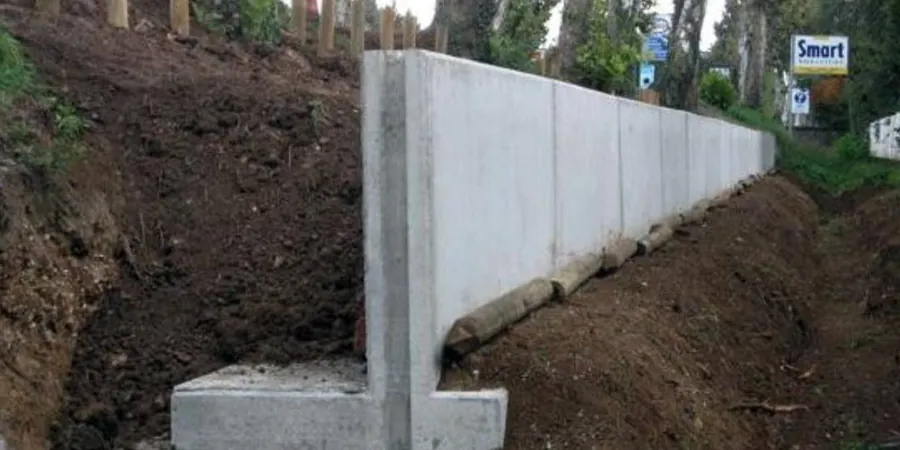
Murfreesboro sits on a tricky boundary between the Eastern Highland Rim and the Central Basin. That means limestone bedrock with pockets of deep, plastic clay and a real risk of sinkholes. Standard retaining wall designs fail here. We see it in subdivisions off Veterans Parkway and commercial builds along Medical Center Drive. The claystone saprolite expands when wet and loses strength fast. A retaining wall in Murfreesboro has to handle more than just lateral earth pressure. It has to work with the karst geology, not against it. Our approach starts with the subsurface—always. We correlate SPT refusal depths with rock quality before selecting wall type. For sites with soft clay over pinnacled rock, we often recommend drilled shaft-supported walls. For shallower bedrock, a cantilever gravity wall can work. The key is knowing what’s underground before you commit. A slope stability analysis often runs parallel to wall design here because many Murfreesboro lots have 10 to 20 feet of grade change across the buildable area.
In Murfreesboro’s karst terrain, a retaining wall fails most often from water pressure buildup behind the stem, not from the soil’s shear strength.
Scope of work
Murfreesboro’s population hit 165,000 in 2024 and keeps climbing. That growth pushes development onto marginal land—steeper lots, deeper clay, closer to sinkhole-prone zones. Our retaining wall designs address these conditions with site-specific parameters, not textbook defaults. We run direct shear on undisturbed Shelby tube samples from the stiff clay layer. We measure residual friction angles because the overconsolidated Porter’s Creek clay can drop from peak to residual strength with just a few inches of movement.
We design to ASCE 7-22 for seismic and IBC 2021 for structural loads. For a 15-foot wall in a commercial setting, surcharge from adjacent parking or future building footings changes the load path completely. We model that in GeoStudio or LPILE. Anchored walls with tiebacks become necessary when the right-of-way limits the excavation footprint. Mechanically stabilized earth walls with geogrid reinforcement perform well on the flatter benches of the city’s east side. Every design includes a drainage plan—wall failure in Murfreesboro usually traces back to water pressure behind the stem, not the soil strength itself.
Q&A
What type of retaining wall works best in Murfreesboro’s clay soil?
It depends on the cut height and proximity to rock. For walls under 10 feet with good drainage, a reinforced concrete cantilever wall on a spread footing can work if bearing is adequate. When the clay is deep or backslope is steep, an MSE wall with geogrid reinforcement often costs less and tolerates more settlement. For cuts near property lines, a soldier pile and lagging wall with tiebacks minimizes excavation width.
How much does a retaining wall design cost in Murfreesboro?
A retaining wall design package—including site investigation, stability analysis, structural calculations, and stamped drawings—runs between US$1,040 and US$3,970 depending on wall height, geologic complexity, and whether rock coring or piezometers are needed.
Do I need a retaining wall if my lot has only 4 feet of grade change?
Maybe not a full engineered wall, but 4 feet of cut in Murfreesboro’s expansive clay can still creep over time. We sometimes recommend a reinforced soil slope or a small segmental block wall with a drainage blanket behind it. The trigger for an engineered wall here is less about height and more about what’s at the top and bottom of the slope—a house, a road, a drainage easement.