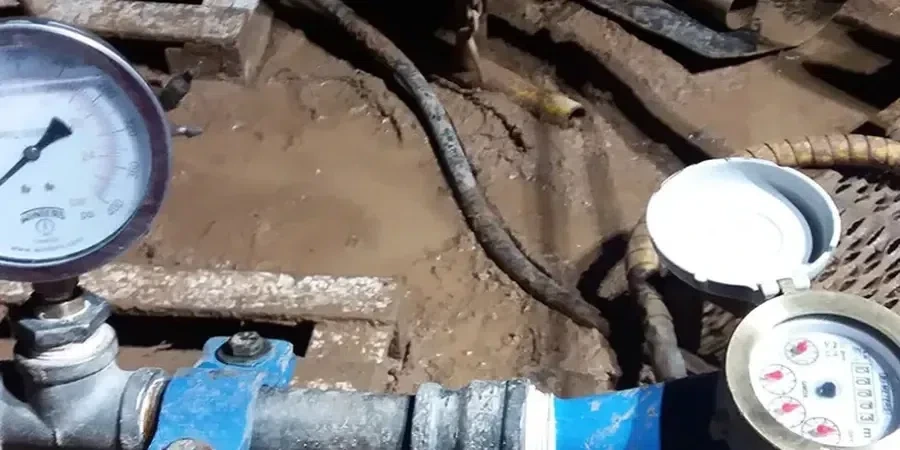
We see it too often in Murfreesboro: a retention basin designed with lab perm values that don't match the fissured limestone reality underground. Lab tests on a 100 mm remolded specimen cannot capture secondary porosity from joints, solution channels, or the deeply weathered epikarst typical of the Stones River Group formations. The result is either an over-designed drainage blanket or, worse, unexpected seepage paths under a foundation. A field permeability test run at the actual depth of interest eliminates that guesswork. For projects near the West Fork Stones River where alluvial deposits mix with karst features, combining Lefranc testing in soil with Lugeon testing in the underlying rock provides a complete hydrogeologic profile without relying on empirical correlations alone.
Lab permeability on a 4-inch Shelby tube misses the fracture that controls the aquifer. Field tests measure what actually flows.
Area-specific notes
A stormwater infiltration trench off Medical Center Parkway was designed for 2.5 in/hr based on a desktop soil survey. Within three wet seasons, the trench ponded and overflowed into adjacent commercial lots, triggering a stop-work on the expansion phase. The post-mortem showed the actual field K was 0.3 in/hr in the silty clay horizon at 6 ft depth—an order of magnitude lower. A half-day of Lefranc testing during the initial geotech investigation would have flagged the discrepancy. In Murfreesboro's karst terrain, perched water tables and vertical conduits can short-circuit seepage models completely. Without in-situ permeability data, drainage design, dewatering plans, and grouting decisions rest on assumptions that fail when the first heavy spring rain saturates the overburden and fills the hidden solution voids below.
Q&A
How much does field permeability testing cost in Murfreesboro?
A typical program with two to three test intervals runs between US$640 and US$950, depending on depth, access conditions, and whether we mobilize a standalone rig or integrate testing with an existing SPT drilling program.
How long does it take to get results from a Lefranc or Lugeon test?
Field data is recorded on calibrated flow meters and pressure transducers. We typically deliver interpreted K values and pressure-flow plots within 48 hours of completing the field work, with a full report following within three business days.
Which test is appropriate for karst limestone in Murfreesboro?
Lugeon testing with a double packer is the standard method for fractured carbonate rock. The packer isolates a specific interval, so we can measure the permeability contribution of individual fractures or solution features without interference from the rest of the borehole.
Can you run a permeability test in the same borehole as an SPT?
Yes. We frequently sequence SPT sampling and permeability testing in the same hole. The borehole is advanced, SPT is performed, the sampler is retrieved, and the test interval is isolated for a Lefranc test before advancing further. This saves mobilization cost and provides paired strength-permeability data at the same depth.