Murfreesboro’s growth didn’t stop at the square. Since the 1980s the city pushed into the karst lowlands along the West Fork Stones River, where soil profiles flip from stiff clay to silty sand in less than 40 vertical feet. That stratigraphic jump wrecks gradation assumptions fast. A complete grain size analysis—dry sieve plus hydrometer—gives us the particle distribution from coarse gravel down to the 2-micron clay fraction. Without that curve, you’re guessing at drainage, frost susceptibility, and compaction behavior. We run the full ASTM D422 and D6913 suite in our IBC-aligned lab. For deeper exploration where SPT refusal hits rock, we often pair the gradation data with a seismic refraction survey to map the rockhead before setting pier depth.
A 10% shift in fines content can move a soil from SM to SC—and that changes the allowable bearing pressure by 30% under IBC Table 1806.2.
Scope of work
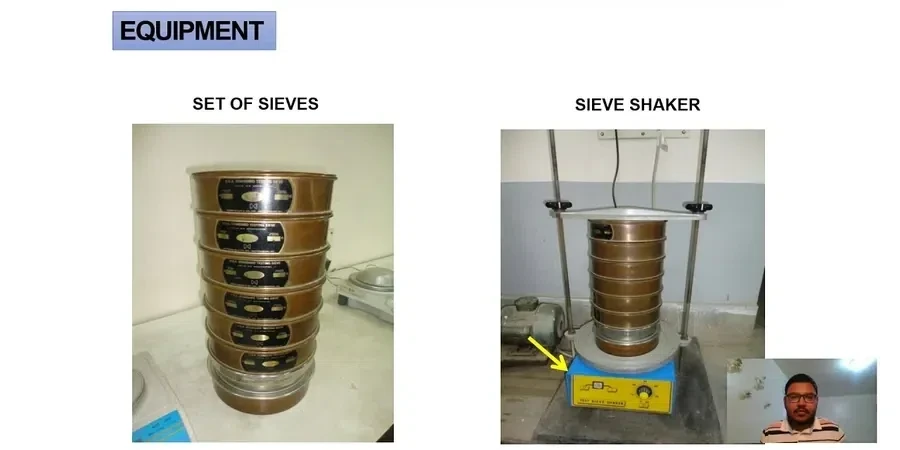
ASTM D6913 governs the sieve stack, and ASTM D422 (or D7928) drives the hydrometer side. IBC Section 1803 requires soil classification per USCS, and in Rutherford County that means nailing the silt-versus-clay boundary. Our lab hydrometers are calibrated with sodium hexametaphosphate dispersion, read at 0.5, 1, 2, 5, 15, 30, 60, 240, and 1440 minutes. The sieve train runs 75 mm to No. 200, with wash-through on the 75-micron pan. Typical Murfreesboro samples plot as silty sand (SM) or lean clay with sand (CL), depending on whether the borrow came from the Stones River terrace or the limestone residuum. When the gradation curve flags gap-graded material, we cross-check with
Proctor compaction to nail maximum dry density before any fill spec gets written.
Q&A
How long does a grain size analysis take in your Murfreesboro lab?
Standard turnaround is 3 business days from sample delivery. The hydrometer side runs a minimum 24 hours of sedimentation readings. Rush processing can deliver results same-week if we receive the sample by Tuesday morning and you flag it at login.
What does a grain size analysis cost for a Rutherford County project?
A full sieve-plus-hydrometer package typically runs between US$100 and US$200 per sample, depending on gravel content and whether we need to split the sample. Wash-through sieve-only runs at the low end of that range. We’ll confirm before testing.
Do you accept disturbed bag samples from Murfreesboro drillers?
Yes. Most of our gradation samples arrive as disturbed bag material from SPT splits or hand-auger borings. We dry the sample at 110°C, weigh it, and run a full visual per ASTM D2488 before starting the mechanical analysis.
Can you classify the soil for IBC bearing pressure tables?
The grain size analysis plus Atterberg limits gives us the full USCS classification—SM, SC, CL, CH, GP-GM, etc. That classification maps directly to IBC Table 1806.2 presumptive bearing pressures. We include the USCS symbol and group name on every report.