← Home · Roadway

Flexible Pavement Design in Murfreesboro: Data-Driven Solutions for Local Soils

Together, we solve the challenges of tomorrow.

EXPLORE →

Murfreesboro sits at roughly 620 feet above sea level on the eastern edge of the Central Basin, a geology that surprised more than one contractor when a simple parking lot turned into a swelling-clay claim. With over 165,000 residents and counting, the city adds pavement daily, and every new lane-mile sits atop the same silty clays that heave in wet winters and crack in dry August heat. A flexible pavement design that ignores subgrade variability here becomes a maintenance liability within three seasons. Our approach ties laboratory CBR, resilient modulus estimates, and local rainfall data into a layered elastic model that predicts rutting and fatigue life before the first truck rolls. We complement the subgrade investigation with in-situ permeability testing where drainage is questionable, and run grain-size analysis on base materials to verify they meet TDOT gradation bands, because a cheap base on reactive clay is not savings; it is deferred demolition.

Pavement fails from the bottom up. In Murfreesboro, that bottom is a moisture-sensitive clay that demands a design number backed by a real CBR test, not a county average.

Scope of work

Middle Tennessee Boulevard and the Medical Center Parkway expansion taught the local engineering community a clear lesson: pavement performance here is a subgrade story. The asphalt may be identical to what they lay in Nashville, but the underlying red-brown clays of the Ridley Limestone formation behave differently, often losing strength when moisture content climbs above optimum. Our flexible pavement design process starts with a forensic look at the soil profile. We pull Shelby tubes for lab resilient modulus, correlate field DCP data with CBR, and build a multilayer model that respects the actual support conditions. For commercial lots where truck loading repeats hundreds of times daily, we often recommend a CBR road investigation campaign to map weak pockets across the site, then use the results to design a mechanically stabilized subgrade that distributes stress without over-thickening the asphalt. The economics are straightforward: the right structural number for the right subgrade, backed by local lab numbers, not generic tables.
Flexible Pavement Design in Murfreesboro: Data-Driven Solutions for Local Soils
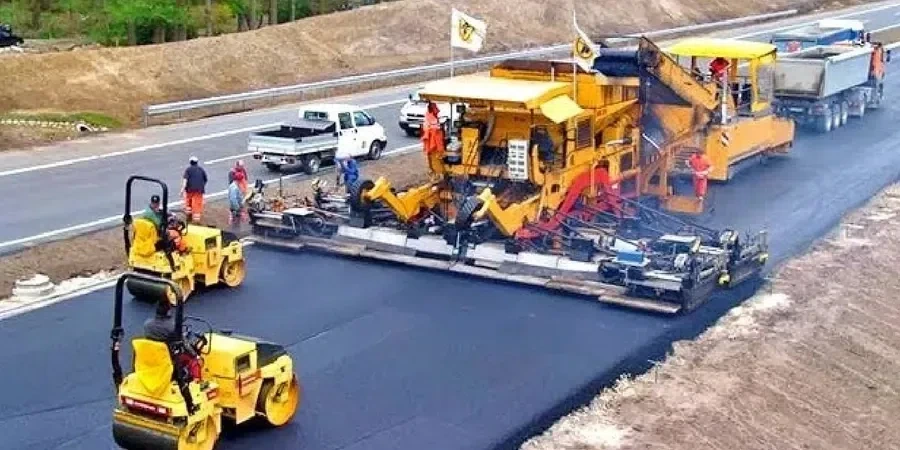
Technical reference image — Murfreesboro

Area-specific notes

The FWD trailer on Medical Center Parkway registered deflections that did not match the as-built structural number, and the explanation was sitting two feet below the subgrade: a network of solution cavities in the limestone that had slowly migrated fines downward, leaving the pavement bridging a void. Karst is not a hypothetical risk in Murfreesboro; it is the geological inheritance of the Stones River watershed. A pavement designer who skips the geophysical step may never see the problem until the asphalt sags. We integrate seismic refraction profiles where drill log spacing misses karst features, and cross-check with resistivity surveys that highlight low-density zones before they become sinkholes. The pavement structure then gets a geogrid-reinforced separation layer that spans small voids and buys time for detection. In this town, the biggest risk to flexible pavement is not traffic; it is the ground dissolving underneath it.

Need a geotechnical assessment?

Reply within 24h.

Email: contact@geotechnicalengineering.biz

Technical parameters


ParameterTypical value
Design methodAASHTO 1993 (structural number) + layered elastic analysis
Target reliability85% for arterials, 75-80% for local roads per TDOT practice
Subgrade characterizationLab CBR, resilient modulus (Mr), swell potential
Base course specTDOT 303.01 graded aggregate, CBR ≥80% at 95% compaction
Asphalt layerPG64-22 binder typical; PG70-22 for high-traffic intersections
Drainage coefficientMi = 0.8–1.0, adjusted for local rainfall and shoulder type
Design ESALsComputed from traffic study; typical range 0.5–5 million for 20-year life

Linked services

01

Subgrade Evaluation & CBR Testing

Field DCP and lab CBR per ASTM D1883 on Shelby tube samples, mapped across the project footprint to identify weak zones requiring treatment or undercut.

02

Traffic Analysis & ESAL Computation

Conversion of truck counts, axle loads, and growth projections into 20-year equivalent single axle loads for the design lane, following AASHTO and local TDOT traffic factors.

03

Pavement Structural Design

Layer thickness optimization using AASHTO 1993 equations and layered elastic software, with sensitivity runs for moisture and subgrade modulus variation.

04

Construction QA & Field Verification

Nuclear gauge density checks, proof rolling observation, and FWD spot testing to confirm that the as-built structure meets the design structural number before acceptance.

Standards used


AASHTO 1993 Guide for Design of Pavement Structures (with TDOT supplemental specifications), ASTM D1883-21 Standard Test Method for California Bearing Ratio (CBR) of Laboratory-Compacted Soils, ASTM D7369-20 Standard Test Method for Determining the Resilient Modulus of Soils and Aggregate Materials, TDOT Standard Specifications for Road and Bridge Construction (current edition, Section 300-series)

Q&A

What is the typical cost range for a flexible pavement design study in Murfreesboro?

For a commercial or subdivision project, the investigation and design package typically falls between US$1,770 and US$4,640, depending on the number of borings, lab tests required, and whether geophysical layers are added for karst screening. We scope each proposal to match the project footprint and traffic class, so you are not paying for a highway study on a parking lot.

Why does Murfreesboro need site-specific CBR instead of a regional default value?

The residual clays here can vary from CBR 2 to CBR 8 within a single site, and TDOT defaults do not capture that spread. Using an assumed value when the real number is low leads to under-designed thickness and premature rutting. Site-specific testing pays for itself by avoiding a single asphalt overlay cycle.

How do you account for karst risk in a flexible pavement section?

We add a geophysical screening step (seismic refraction or electrical resistivity) where the boring log encounters voids, soft zones, or erratic rock depth. When risk is confirmed, the pavement section includes a biaxial geogrid at the subgrade-base interface and, in high-risk areas, a thick aggregate bridging layer designed to span small voids until they can be grouted or excavated.
Location and service area

We serve projects across Murfreesboro and its metropolitan area.

View larger map