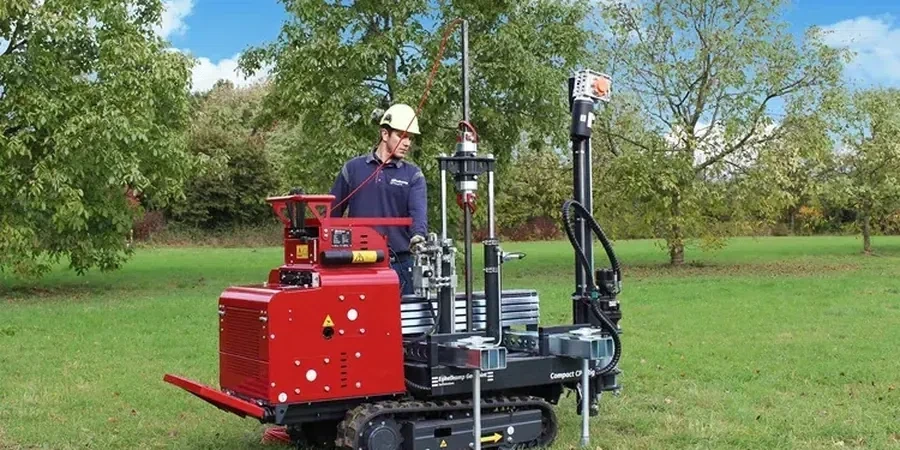
The karst limestone that underlies Murfreesboro doesn't give you second chances. At roughly 620 feet above sea level on the Stones River watershed, the residual clays and weathered rock here change drastically over short distances—sometimes within the same lot. A standard split-spoon can smear that contact zone. We run CPT because it reads the transition in real time, logging tip resistance and sleeve friction every two centimeters. That resolution matters when you're placing footings near the Gateway area or expanding a facility off I-24, where chert float and solution cavities are part of the profile. The cone doesn't guess. It pushes through the red clay, hits the weathered limestone, and tells you exactly where bearing begins—and where it doesn't. For sites with suspected voids, pairing CPT data with resistivity profiles helps map the subsurface before you commit to excavation.
When the cone hits refusal on pinnacled limestone at 15 feet and the neighbor's boring went to 40, you have the data to make a real bearing decision—not an assumption.
Scope of work
Sites north of Medical Center Parkway tend to sit on stiffer, low-moisture clays that push back hard on the cone—friction ratios stay tight, pore pressure dissipation is fast. Move south toward the Blackman area, and you encounter more alluvial influence from the West Fork: softer silts, higher moisture, and sometimes organics at depth. The CPT catches these shifts immediately. We run a 15 cm² cone with a pore pressure transducer at the u2 position, so you see not just soil behavior type from the Robertson chart, but also how fast that water pressure bleeds off—critical for estimating settlement rate under load. In the transition zones near Cherry Lane, we've measured corrected cone resistance swing from 8 MPa to over 40 MPa within a vertical meter. That's the limestone contact.
No other test delivers that kind of boundary definition at production speed. On larger commercial lots, we often run CPT alongside
SPT drilling at select locations so the lab can calibrate index properties against the continuous electronic log, giving you the best of both data sets without doubling the budget.
Area-specific notes
Rutherford County enforces IBC 2021 with local amendments, and the geotechnical report is the first thing the plans examiner checks. CPT data that stops short of refusal on limestone leaves the bearing stratum undefined—and that triggers a stop-work on deep foundations or slab-on-grade designs east of the city where pinnacled rock is common. The cone's continuous profile catches the diagenetic hardpans and the soft seams between them, so the structural engineer isn't designing for an average N-value that hides a weak layer. Pore pressure data also flags drainage problems before you pour: a slow dissipation curve in the Murfreesboro silty clays means consolidation will take longer than the construction schedule allows. That's not a soil problem—it's a sequencing problem, and the CPT reveals it during the investigation phase. On sites within the Stones River flood fringe, undrained shear strength estimates from the cone log directly inform bearing capacity calculations per the IBC Section 1806 presumptive load values, replacing conservative table values with measured behavior.
Q&A
How much does a CPT test cost in Murfreesboro?
Budget between US$150 and US$240 per push location for standard cone penetration testing in the Murfreesboro area. The final cost depends on access conditions, total depth per push, and whether you need pore pressure dissipation readings. We generate a per-location quote once we review the site address and your foundation plan.
How deep can the CPT go in Rutherford County soils?
In the residual clays and silts that cover much of Murfreesboro, we typically reach 60 to 80 feet before encountering limestone refusal. The cone stops when tip resistance exceeds the rig's reaction capacity or hits competent rock. In the Blackman area with softer alluvial profiles, we may push the full 100-foot rod string before refusal.
Does CPT replace soil borings for IBC compliance?
CPT provides continuous stratigraphic data that satisfies IBC 2021 Section 1803 requirements when combined with index testing on samples from companion borings. The code accepts cone penetration data for soil classification, bearing capacity estimation, and liquefaction assessment. Most Murfreesboro projects run CPT as the primary investigation with one or two SPT borings for laboratory correlation.
What happens when the cone hits a void or cavity?
The cone records a sudden loss of tip resistance and sleeve friction, and the pore pressure transducer may show a pressure drop. The push continues until the cone re-engages material or reaches refusal. We flag these intervals in the log and recommend cross-checking with electrical resistivity or a targeted boring if the cavity is within the foundation influence zone.