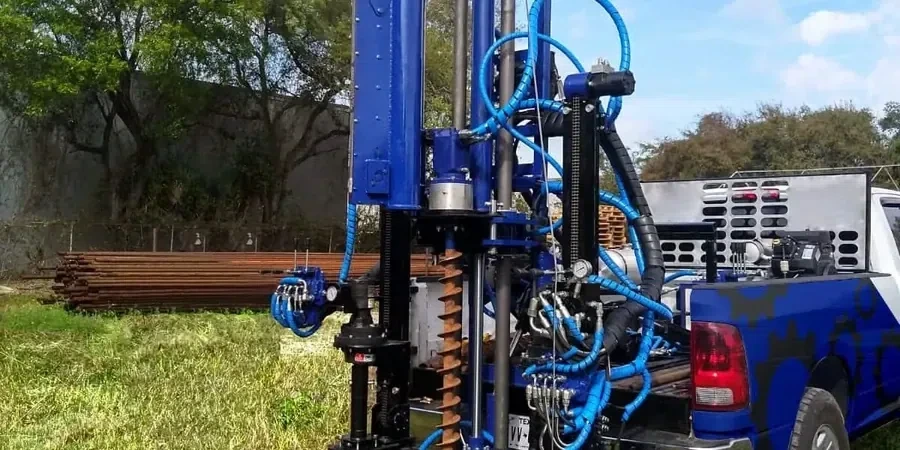
Site investigation in Murfreesboro addresses the critical need to characterize the shallow limestone bedrock, residual clays, and chert-laden soils of Tennessee’s Central Basin before any structural load is applied. Our approach integrates ASTM D1586 standard penetration testing with a focused CPT (Cone Penetration Test) program to map pinnacled rock profiles and identify solution features common in the Ridley and Lebanon limestone formations. This data directly supports foundation design in accordance with the locally adopted International Building Code and Rutherford County stormwater management requirements.
These investigations are mandatory for commercial pads along the Medical Center Parkway corridor, residential subdivisions on undercut slopes, and infrastructure upgrades where karst-related subsidence is a known risk. Pairing subsurface data with CPT (Cone Penetration Test) records allows engineers to refine bearing capacity calculations and predict settlement with greater accuracy, reducing over-excavation costs. A properly scoped program is the most cost-effective insurance against change orders and structural distress in this geologically complex market.
Full design of active prestressed anchors for soldier pile and secant pile walls, including bond length calculation, tendon sizing, and lock-off load specification per PTI DC35.1.
Design of passive inclusions for top-down excavation support in stiff residual clays, with pullout capacity verified through field testing.
Performance, proof, and extended creep tests executed with calibrated hydraulic jacks and digital load cells, documenting load-displacement behavior.
Specification of encapsulation systems for aggressive groundwater environments, including epoxy-coated strand, corrugated sheathing, and post-grouting details.
PTI DC35.1-14: Recommendations for Prestressed Rock and Soil Anchors, FHWA Geotechnical Engineering Circular No. 4: Ground Anchors and Anchored Systems, ASTM A416/A416M: Standard Specification for Low-Relaxation, Seven-Wire Steel Strand for Prestressed Concrete, IBC 2021 Chapter 18: Soils and Foundations, OSHA 1926 Subpart P: Excavations
For a project with 20 to 40 anchors, the combined design, submittal preparation, and field testing program typically ranges from US$970 to US$3,520, depending on the number of verification tests required and the complexity of the corrosion protection system specified.
Active anchors are prestressed after installation to apply a known force to the structure before any soil movement occurs; passive anchors develop their force only as the ground deforms. In Murfreesboro excavations deeper than 15 feet, active tiebacks are generally preferred because they limit lateral wall deflection to under 1 inch, which protects adjacent utilities and pavements.
With proper corrosion protection, a Class I anchor system can have a design life exceeding 75 years. The primary threat in this region is not uniform corrosion but pitting attack where acidic groundwater contacts exposed steel in imperfectly grouted zones, which is why the design emphasizes centralized tendon placement and post-grouting of the bond length under pressure.
The minimum dataset includes SPT N-values and recovery ratios through the bond zone, unconfined compression tests on rock core, drained direct shear tests on undisturbed clay samples, and groundwater pH and resistivity measurements. Where the bond zone is in weathered limestone, a downhole camera survey of at least one borehole is recommended to identify open joints or cavities that could cause grout loss during installation.
We serve projects across Murfreesboro and its metropolitan area.