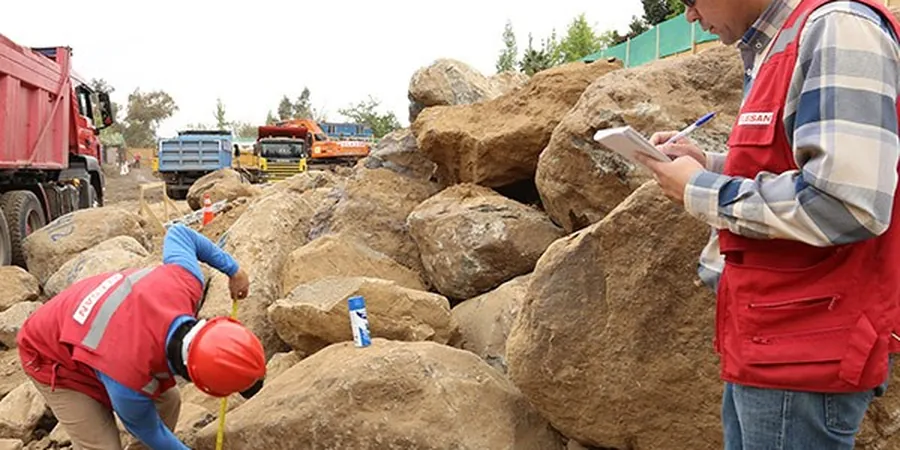
A four-story mixed-use structure planned near the Discovery Center in downtown Murfreesboro stalled for three months because the initial geotechnical report missed a pocket of highly plastic clay within the limestone residuum. The developer learned the hard way that Rutherford County’s geology, shaped by the Ordovician Lebanon Limestone and the overlying clay-rich regolith, demands more than a routine boring log. A proper soil mechanics study quantifies shear strength, consolidation parameters, and volume-change potential before the first yard of concrete is poured. Our laboratory runs the full suite: unconsolidated-undrained triaxial on Shelby tube samples extracted from the stiff silty clays that dominate the Murfreesboro area, one-dimensional consolidation following ASTM D2435 to predict settlement under the sustained loads typical of mid-rise construction along Medical Center Parkway, and Atterberg limits that often reveal PI values above 35 in the weathered shale seams. When the subsurface investigation hints at solution cavities or pinnacled rock, we complement the program with grouting feasibility assessments to evaluate pressure-grouting as a mitigation strategy before foundation installation, ensuring the bearing stratum is continuous and competent.
In Murfreesboro’s karst terrain, a soil mechanics study must resolve the contrast between stiff residual clay and the irregular bedrock surface, because differential settlement across a single building footprint can exceed tolerable limits even when average bearing pressures are conservative.
Scope of work
A soil mechanics study in this region starts with undisturbed sampling driven by a hydraulic piston sampler mounted on a drill rig capable of penetrating the stiff, desiccated crust that forms during Murfreesboro’s hot, dry summers, when the mean high temperature reaches 89 °F in July and surface soils lose moisture to depths of six feet or more. The samples are sealed in the field with microcrystalline wax and transported to our climate-controlled lab within 24 hours, where technicians log the recovery ratio and immediately begin trimming specimens for triaxial and consolidation cells. Direct shear tests on reconstituted specimens, run under consolidated-drained conditions per ASTM D3080, give us the effective friction angle of the residual silts that mantle the limestone bedrock across much of the city. We pay particular attention to the moisture-density relationship using modified Proctor compaction (ASTM D1557) because the local practice of reusing on-site clay as structural fill requires precise control of lift thickness and compactive effort to avoid post-construction settlement in parking lots and approach slabs. Grain-size distribution curves, obtained through combined sieve and hydrometer analysis, frequently show a gap-graded profile in the alluvial terraces along the West Fork Stones River, a detail that influences both permeability estimates and filter design for subsurface drainage systems.
Area-specific notes
Murfreesboro sits at an elevation of approximately 619 feet above sea level on the eastern flank of the Central Basin, a physiographic province where the limestone bedrock is mantled by residual clays that can vary in thickness from two feet to more than forty feet over distances of less than a hundred yards. The city has recorded a population surge past 165,000 residents, driving subdivision development onto terrain where the risk of cover-collapse sinkholes is well documented by the Tennessee Division of Geology. A soil mechanics study that does not include consolidation testing on the saturated, low-density clays found in filled sinkholes will miss the potential for sudden, localized settlement that can crack slab-on-grade foundations within the first two years of service. The 2001 magnitude-4.1 earthquake centered near Manchester, Tennessee, though modest, reminded engineers that the Eastern Tennessee Seismic Zone can generate ground motions sufficient to trigger pore-pressure buildup in loose granular lenses interbedded with the clay. Our analysis incorporates site-specific shear-wave velocity profiles to refine the seismic site class per ASCE 7, moving beyond the default Site Class D assumption that can penalize the structural design with unnecessary seismic forces.
Q&A
What is the typical cost range for a soil mechanics study on a commercial lot in Murfreesboro?
For a standard commercial parcel in Rutherford County, the laboratory testing and engineering analysis typically range from US$3,500 to US$5,210, depending on the number of borings, the depth of sampling, and the specific suite of tests required by the structural engineer and the local building department.
How many undisturbed samples do you need for a reliable consolidation and triaxial program?
We recommend a minimum of three Shelby tube samples per distinct cohesive stratum, spaced vertically to capture the preconsolidation profile. For a site in Murfreesboro where the residual clay extends from 5 to 25 feet below grade, that usually means six to nine undisturbed samples, plus bulk samples of the near-surface fill for compaction testing.
How do you address the karst and sinkhole potential in the laboratory testing plan?
The laboratory program targets the soil filling potential sinkhole features: we run consolidation tests on the soft, high-moisture clays often found in closed depressions and measure the collapse potential under saturated conditions. The results are combined with the rock-surface contour map from the drilling logs to identify zones where the thickness of compressible soil changes abruptly, which is the signature of a paleosinkhole.
Can the soil mechanics study help reduce the seismic design forces on our structure?
Yes. By measuring shear-wave velocity directly or through correlations with undrained shear strength and SPT N-values, we can determine the site class per ASCE 7 Table 20.3-1. Many Murfreesboro sites qualify as Site Class C or better when the stiff residual clay is shallow, reducing the design spectral accelerations compared to the default Site Class D and potentially lowering the structural steel and concrete quantities.
What is the turnaround time from sampling to the final report?
Consolidation tests require incremental loading over a period of seven to ten days per specimen, so a complete program with triaxial, direct shear, and Proctor tests typically delivers the draft report within four weeks of sample receipt. We provide preliminary bearing-capacity values within ten business days to keep the foundation design moving while the consolidation cells are still running.