← Home · Improvement

Vibrocompaction Design in Murfreesboro: Improvement for Karst Margins

Together, we solve the challenges of tomorrow.

EXPLORE →

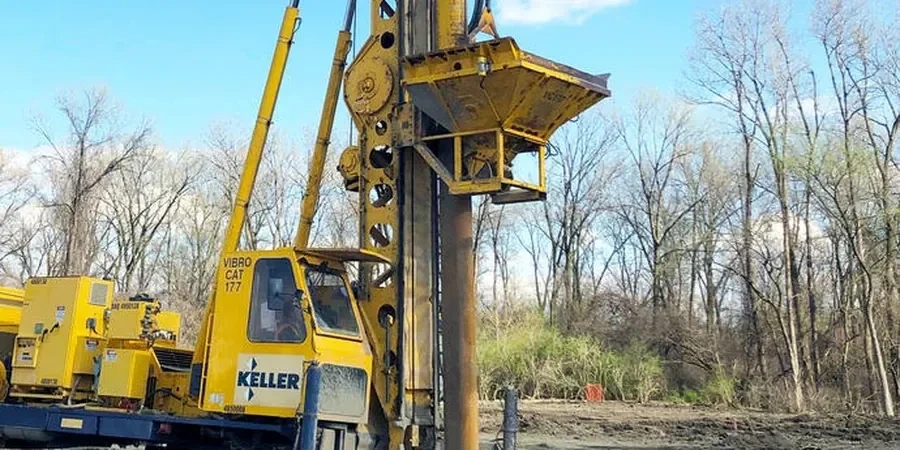
A depth vibrator suspended from a crawler crane is the workhorse behind any reliable vibrocompaction program, and here in Murfreesboro the rig typically descends through silty sands and weathered rock interfaces that define the Central Basin's transition zones. The eccentric weight inside the probe generates horizontal vibrations that momentarily liquefy the granular matrix, allowing particles to rearrange into a denser state—a process we calibrate using real-time amperage and settlement data. Because the Stones River watershed has deposited lenses of loose alluvium that sit directly above pinnacled limestone, our team combines standard penetration testing with CPT logging to map these contacts before committing to a probe grid. The city’s expanding warehouse and distribution sector along I-24 routinely encounters these conditions, making pre-construction ground treatment a practical step toward stable, uniform bearing capacity.

A well-instrumented vibrocompaction grid in Murfreesboro’s alluvial soils can bring settlement differential below half an inch across a 200-foot warehouse pad, a tolerance that rigid pavement and racking systems demand.

Scope of work

Soil response to vibratory energy varies considerably between Murfreesboro’s northwest commercial corridor and the older residential districts near Middle Tennessee Boulevard. In the northwest, recent alluvial terraces of the West Fork Stones River contain up to 20 feet of loose silty sand that responds rapidly to probe penetration at 6- to 7-foot triangular spacing, often achieving 70% relative density within two passes. By contrast, soils closer to the downtown core carry a higher fraction of residual clay from the underlying Ridley Limestone, which requires supplemental drainage paths—sometimes installed as stone columns along the grid perimeter—to dissipate excess pore pressure during compaction. These contrasts drive our instrumentation choices: we may specify a 130-kW electric vibrator for deep deposits but switch to a 50-kW hydraulic unit where bedrock lies within 15 feet. A pre-production test section, documented under ASTM D6066, allows us to confirm energy penetration, grid geometry, and hold-point amperage before full-scale treatment begins, and the resulting data feeds directly into a site-specific method statement that the structural engineer can reference during foundation design.
Vibrocompaction Design in Murfreesboro: Improvement for Karst Margins
Technical reference image — Murfreesboro

Area-specific notes

Murfreesboro sits on the eastern edge of the Nashville Basin where karst weathering has carved solution channels and clay-filled cutters into the Ridley Limestone. A heavy rainfall season—March through May often brings 5 to 6 inches per month—can flush fines into these subsurface voids, causing sudden loss of ground that no amount of surface compaction can prevent. Vibrocompaction addresses the loose overburden, but it must be paired with careful probing of the rockhead: a sudden drop in amperage during probe advance often signals a cavity or soft clay seam that requires a targeted grouting program to stabilize before compaction continues. Ignoring these karst signatures risks differential subsidence that can shear utility lines and crack slab-on-grade floors within the first two wet seasons. Our field engineers overlay historic sinkhole maps from the Tennessee Geological Survey with CPT refusal depths to flag these zones during the design phase, adjusting probe spacing or adding stone columns where the limestone surface becomes erratic.

Need a geotechnical assessment?

Reply within 24h.

Email: contact@geotechnicalengineering.biz

Technical parameters


ParameterTypical value
Applicable soil types (best response)Sands and gravels with fines content below 12%, N-values under 15
Typical probe depth range in Murfreesboro basin15 to 45 ft, limited by pinnacled bedrock or boulders
Triangular grid spacing (standard)5 to 10 ft, tightened to 4 ft near retaining structures
Relative density target (post-treatment)70–85%, verified by SPT or CPT before and after
Vibrator power class130–180 kW electric or 50–80 kW hydraulic, selected by depth
Pre-production test section requirementASTM D6066, minimum one full grid cell with three probes
Quality control during productionAutomatic data logger recording depth, amperage, and withdrawal rate per probe

Linked services

01

Geotechnical Baseline Report with CPT Integration

We pair electric cone penetration tests with mud-rotary borings to map loose alluvium thickness and bedrock pinnacles across the site, generating a 3D ground model that dictates vibrator depth and grid layout.

02

Vibrocompaction Trial Program

A full-scale test section under ASTM D6066 evaluates probe energy, spacing, and number of passes on your specific soil. We instrument the crane with automatic logging to capture depth-amperage-time curves for every probe.

03

Production Compaction and Real-Time QC

During treatment, a data acquisition system records amperage peaks and withdrawal rates at 0.1-foot intervals. Our field supervisor adjusts hold times and sand backfill volumes on the fly, ensuring uniform densification across the entire footprint.

04

Post-Treatment Verification Testing

After compaction, we execute SPT or CPT soundings at grid centroids to confirm relative density targets. A final report compares pre- and post-treatment N-values, quantifies settlement reduction, and provides foundation design parameters for the structural engineer.

Standards used


ASTM D6066-21: Standard Practice for Determining the Normalized Penetration Resistance of Sands for Evaluation of Liquefaction Potential, ASCE 7-22 Minimum Design Loads and Associated Criteria for Buildings and Other Structures, IBC 2024 Chapter 18: Soils and Foundations, ASTM D1586-18: Standard Test Method for Standard Penetration Test (SPT), ASTM D2487-17: Standard Practice for Classification of Soils for Engineering Purposes

Q&A

What does vibrocompaction design cost for a typical warehouse pad in Murfreesboro?

For a medium-sized industrial lot (40,000 to 80,000 square feet) with loose sands 15 to 25 feet deep, vibrocompaction design and field supervision typically ranges from US$1,520 to US$4,530, depending on the required test section complexity and number of post-treatment verification soundings.

How does the karst geology under Murfreesboro affect vibrocompaction performance?

The pinnacled limestone bedrock common to the Nashville Basin can create abrupt refusal points for the vibrator and may mask solution cavities. Our design phase includes CPT refusal mapping and sinkhole proximity analysis so we can shift probe locations or add grouting ahead of compaction where the rock surface becomes erratic or voids are suspected.

Can vibrocompaction replace deep foundations for a two-story commercial building in Murfreesboro?

In many cases, yes—provided the granular layer extends deep enough to distribute structural loads. After treatment, we often achieve allowable bearing pressures of 4,000 to 6,000 psf and total settlement under one inch, which can eliminate the need for driven piles. A building-specific settlement analysis confirms whether shallow footings become viable.

How long does a vibrocompaction program take from design to final verification?

A typical Murfreesboro project runs four to six weeks: one week for supplementary CPT borings and design, one week for the test section, two to three weeks for production compaction, and one week for post-treatment SPT verification and reporting. Weather delays in spring can extend the schedule, but the technique generally outpaces alternative methods like dynamic compaction.
Location and service area

We serve projects across Murfreesboro and its metropolitan area.

View larger map