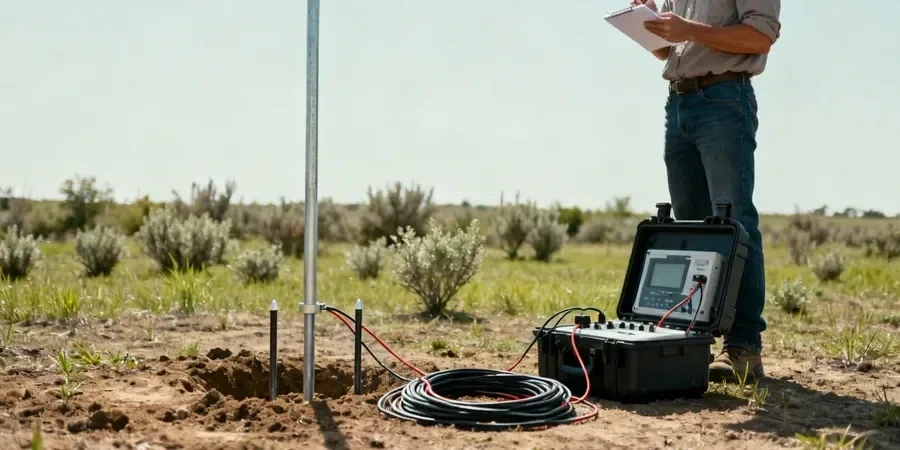
A common mistake we see in Rutherford County is assuming uniform soil conditions between boreholes. Murfreesboro sits on a complex mix of Ordovician limestone residuum and alluvial deposits along the Stones River, and a standard SPT alone won't catch a five-foot-wide solution cavity ten feet down. Electrical resistivity / VES (Vertical Electrical Sounding) fills that gap. By injecting current into the ground and measuring the voltage response at increasing electrode spacings, we build a continuous 2D profile of the subsurface—highlighting clay lenses, fractured bedrock, or water-saturated zones that could destabilize a footing. When combined with SPT drilling to calibrate the resistivity units against actual soil samples, the result is a ground model that makes sense geologically, not just statistically.
Resistivity imaging catches what borings miss: the continuous profile between drill points that reveals hidden cavities, clay seams, or perched water.
Q&A
How deep can a VES survey investigate in Murfreesboro's geology?
With a maximum current electrode spacing of 600 feet (AB/2 = 300 ft), the effective depth of investigation reaches roughly 100 to 150 feet in the limestone residuum, provided the target has sufficient resistivity contrast. In conductive clay-rich soils, the depth of signal penetration decreases, and we adjust the spread accordingly. For deeper targets beyond 150 feet, we typically combine VES with seismic refraction to constrain the interpretation.
What does a VES survey cost for a typical residential lot in Murfreesboro?
For a standard residential or small commercial lot, VES surveys in Murfreesboro run between US$630 and US$940, depending on the number of soundings, the array length required to reach target depth, and site access conditions. A proposal always follows a quick site walk because steep terrain or dense brush affects the setup time.
How do you validate the resistivity results?
Resistivity is a non-unique geophysical method—different subsurface models can produce the same measured curve. We validate by tying each resistivity profile to at least one point of ground truth, usually an SPT boring or a test pit. The boring log provides the layer thicknesses and material types that constrain the inversion model, converting a mathematically possible solution into a geologically probable one.