← Home · Investigation

Exploratory Test Pits in Murfreesboro: Subsurface Verification for Shallow Foundations

Together, we solve the challenges of tomorrow.

EXPLORE →

Murfreesboro’s rapid expansion along the Stones River and the I-24 corridor has transformed its landscape over the past two decades. The city sits on the eastern edge of the Central Basin, where the underlying Ordovician limestone—locally known as the Ridley and Lebanon formations—is often capped by a variable mantle of residual clay and silty alluvium. This geology creates a patchwork of soil conditions that can shift dramatically within a single parcel. When a contractor encounters unexpected chert fragments or a pocket of fat clay at excavation depth, the schedule takes a hit. An exploratory test pit lets you see that stratigraphy with your own eyes before the backhoe ever arrives on site. We’ve opened pits across Murfreesboro, from the Gateway area to the subdivisions off Veterans Parkway, and the one constant is variability. Complementing the visual log with a grain-size analysis helps quantify the fines content that drives shrink-swell behavior, while correlating observations with Atterberg limits gives the design team a clear picture of plasticity risk in the clay horizons.

A test pit in Murfreesboro is the fastest way to ground-truth the interface between residual clay and weathered limestone before the footings are drawn.
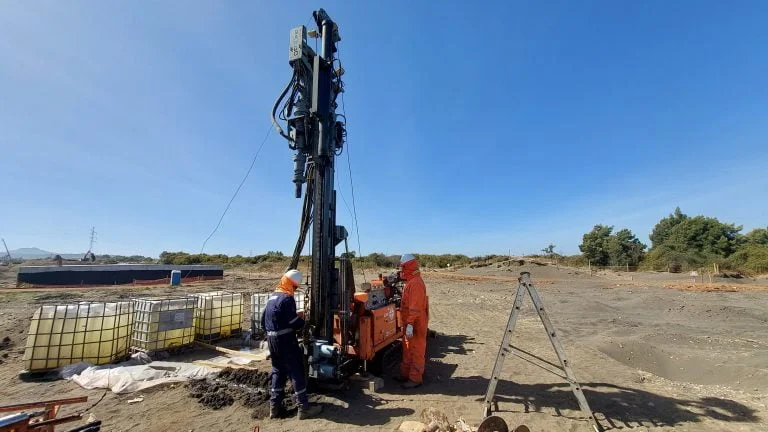
Scope of work

A recent project near the Middle Tennessee Boulevard widening put this into perspective. The site investigation started with a conventional boring that hit refusal at roughly three feet—turned out to be a discontinuous boulder of Fort Payne chert, not the top of competent bedrock. The excavation contractor was ready to mobilize a hammer and assume the whole footprint was the same, which would have been a costly mistake. We opened two exploratory test pits on the opposite corner of the lot and found nearly six feet of stiff, reddish-brown silty clay over weathered limestone. No boulders, no chert float. That single morning of test pit logging saved the owner weeks of unnecessary rock excavation and allowed the structural engineer to proceed with a shallow footing design referenced to the actual soil profile. Visual classification per ASTM D2488, combined with targeted sampling, gives you a level of stratigraphic detail that a drill rig alone cannot always capture. For sites where the depth-to-rock is uncertain, we often pair the test pit program with seismic refraction to map the bedrock surface across the entire buildable area, and when the clay looks marginal we recommend a Proctor test to verify compaction characteristics for the engineered fill specification.
Exploratory Test Pits in Murfreesboro: Subsurface Verification for Shallow Foundations
Technical reference image — Murfreesboro

Area-specific notes

The residual soils across Rutherford County contain a high percentage of montmorillonite-derived clay, and the Murfreesboro area sits within Seismic Design Category C per ASCE 7. That combination—expansive clay overlaying pinnacled limestone in a moderate seismic zone—creates a specific set of failure modes that shallow inspections can miss. A test pit allows direct measurement of the weathered rock surface profile, which in this part of Tennessee can vary by several feet over a distance of ten feet horizontally. We’ve documented pits where clean limestone on one end grades into a soft clay seam on the other, a condition that would cause differential settlement under uniform footing pressure. Seasonal perched water is another factor: the clay-rich residuum drains poorly, and a pit opened in March after heavy rainfall often reveals a saturated zone at three to five feet that is completely dry by August. Designing for the wet condition without verifying the seasonal high-water mark puts the foundation at risk. The test pit provides that direct observation window that no remote sensing tool can replicate.

Need a geotechnical assessment?

Reply within 24h.

Email: contact@geotechnicalengineering.biz

Technical parameters


ParameterTypical value
Standard test pit depth8 to 14 ft (excavator reach dependent)
Typical pit width30 to 48 inches (safe entry per OSHA Subpart P)
Visual classification standardASTM D2488 / D2487 (USCS)
In-situ sampling methodBlock samples, Shelby tubes, bulk bags per ASTM D4220
Groundwater observationLogged if encountered; seasonal perched water common in Murfreesboro residuum
Applicable foundation codeIBC Chapter 18 / ASCE 7-22 Section 12.13
Bedrock geologyRidley & Lebanon Limestone (Ordovician) with chert interbeds
Shrink-swell indicatorClay fraction > 30% with PI > 25 (ASTM D4318)

Linked services

01

Stratigraphic Logging & Sampling

We excavate to the target depth, log soil and rock horizons using ASTM D2488/D2487, and collect representative samples for laboratory index testing. Each log notes the presence of chert nodules, weathering grade of the limestone, and any seepage zones encountered.

02

Foundation Subgrade Verification

For projects where footings are already designed, the test pit serves as a proof excavation. We confirm that the bearing stratum matches the geotechnical report assumptions and flag any soft zones, voids, or solution features in the limestone that could require over-excavation or dental concrete.

Standards used


ASTM D2488 (Visual-Manual Classification), ASTM D4220 (Preservation and Transport of Soil Samples), IBC 2021 Chapter 18 (Soils and Foundations), OSHA 29 CFR 1926 Subpart P (Excavation Safety)

Q&A

How deep can a test pit go in Murfreesboro’s clay-limestone residuum?

With a mid-size excavator we typically reach 12 to 14 feet before bucket refusal on competent limestone. In the residual clay profile common around Murfreesboro, many pits bottom out at the weathered rock interface around 8 to 10 feet. Deeper investigation requires auger drilling or rotary coring.

What does an exploratory test pit cost in Rutherford County?

For a standard two-pit program with logging and sampling in the Murfreesboro area, the cost generally falls between US$460 and US$910 per pit, depending on depth, access constraints, and the number of samples collected. Mobilization is quoted separately based on location.

Do you need a permit to open a test pit on private property in Murfreesboro city limits?

No city permit is required for a temporary test pit on private land, but Tennessee One-Call (811) must be notified at least 72 hours before excavation, and the pit must be backfilled and compacted the same day per OSHA requirements. If the property lies within a floodplain overlay, additional coordination with the Stormwater Division may apply.

Location and service area

We serve projects across Murfreesboro and its metropolitan area.

View larger map