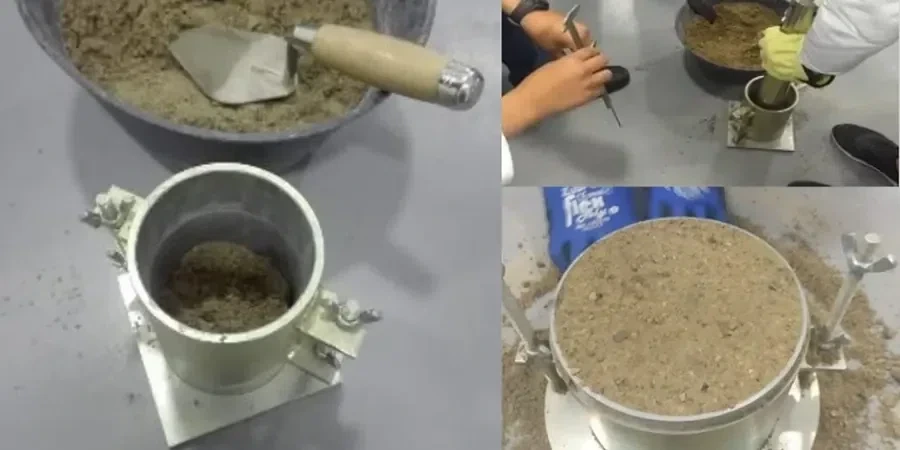
With Murfreesboro sitting at roughly 620 feet above sea level on the eastern edge of the Central Basin, the soils here tell a distinct geological story that directly impacts compaction. Most of our field calls take us to sites where the near-surface material is a stiff red clay derived from weathered limestone—the same Ordovician bedrock that underlies much of Rutherford County. Compact that clay too wet and you get a spongy subgrade that will haunt the pavement; too dry and the lift stays loose no matter how many passes the roller makes. The Proctor test eliminates that guesswork by establishing a precise moisture-density relationship in the lab before any fill is placed. We run both Standard (ASTM D698) and Modified (ASTM D1557) methods depending on the project specification, and we pair the results with field density checks using the sand cone density method for a complete QA/QC loop. Having that curve in hand before the first truckload of borrow arrives is what separates a smooth inspection from a failed lift and a re-compaction order.
A Proctor curve drawn on local clay is the difference between a pavement that lasts 15 years and one that develops alligator cracks after the second freeze-thaw cycle.
Scope of work
A subdivision off Veterans Parkway and a commercial pad near the Stones River battle completely different compaction challenges, even though they are only a few miles apart. The Veterans Parkway site might encounter stiff residual clay with a plasticity index above 20, where the Modified Proctor (56,000 ft-lbf/ft³ compactive effort) is mandatory to simulate the energy of modern sheepsfoot rollers. Down by the Stones River floodplain, the natural moisture content often runs higher than optimum, and the Standard Proctor (12,400 ft-lbf/ft³) often gives a more realistic target for lighter equipment working on utility trench backfill. We determine maximum dry density and optimum moisture content using a 4-inch mold for Standard or a 6-inch mold when oversize particles require scalp-and-replace corrections per ASTM D4718. The lab report includes the full compaction curve with ZAV line, so the field technician can immediately spot whether a failing density reading is a moisture problem or a material change. We also run one-point Proctor checks during construction to verify that the borrow source has not shifted from the original lab sample.
Area-specific notes
The Ordovician limestone residuum that covers much of Murfreesboro creates a specific compaction risk that general textbooks do not address well: the transition from cut to fill over pinnacled rock. At the bottom of a cut, you are sitting on rock with refusal; ten feet away, the weathered clay saddle between pinnacles can be fifteen feet deep. If the structural fill placed over that variable subgrade is compacted to a uniform Proctor target without accounting for the stiffness contrast, differential settlement will telegraph through the slab within the first two wet seasons. We see this pattern most often on commercial pads along Medical Center Parkway where the original terrain was karst-influenced. Our approach uses the Proctor curve to set a density target but adds a moisture conditioning window based on the clay's plasticity index, so the fill placed directly over the rock transitions does not shrink away from the subgrade contact. When the specification calls for 95% of Modified maximum density, we also recommend a proof-roll with a loaded dump truck to identify soft spots that a nuclear gauge might miss because the underlying void skews the reading.
Q&A
How much does a Proctor test cost in Murfreesboro?
A Standard Proctor (ASTM D698) runs between US$110 and US$150, while the Modified Proctor (ASTM D1557) typically falls between US$150 and US$200. The price depends on whether we are testing a single sample or running a full suite with oversize correction and one-point verification checks during construction.
Which Proctor method do I need for a residential slab in Murfreesboro?
Most residential specifications in Rutherford County call for the Standard Proctor (ASTM D698) for building pads, with compaction to 95% of maximum dry density. If the geotechnical report specifies a higher level of compaction or the pad will support heavy masonry finishes, the Modified Proctor may be required. We always confirm against the project geotechnical report before running the test.
What sample size do you need for a Proctor test?
For a Standard Proctor using the 4-inch mold, we need about 40 to 50 pounds of representative material in sealed buckets. For Modified Proctor with oversize correction, plan on 80 to 100 pounds. The sample must be protected from moisture loss between the field and the lab—we provide sealed containers and can coordinate pickup from your site in Murfreesboro.