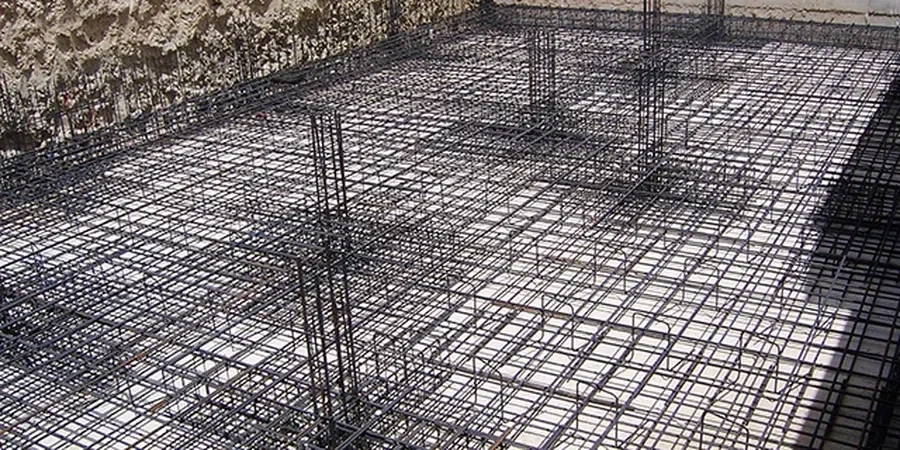
In Murfreesboro, the geology doesn't read textbooks. The city sits squarely on the Ordovician Ridley Limestone, part of the Stones River Group, where the rock is dissected by ancient vertical joints and dissolution channels. That means you can have competent limestone at five feet and a clay-filled sinkhole twenty feet away on the same lot. A raft or mat foundation design becomes a rational way to bridge those subsurface irregularities without turning the project into a surgical exercise in deep foundations. We have seen too many projects on Medical Center Parkway or near the Gateway corridors where isolated footings would have required such disparate bearing elevations that the excavation alone killed the budget. A properly engineered mat foundation spreads structural loads across a broad footprint, reducing differential settlement risk in a way that works with Murfreesboro's geology rather than fighting it. For preliminary site characterization we often pair the mat foundation analysis with an SPT drilling program to map refusal depth and rock quality, and in areas with deeper soil cover a CPT test helps refine the stratigraphy before we commit to the foundation geometry.
In karst terrain like Murfreesboro's, a mat foundation isn't just a slab; it's a structural diaphragm designed to tolerate the loss of a column of support without progressive collapse.
Area-specific notes
Murfreesboro's growth since the 1990s has pushed development into areas that were historically pastureland, where the karst features were never mapped with engineering precision. The Stones River and its tributaries, particularly Lytle Creek, have carved a drainage network that accelerates subsurface dissolution along fracture traces. On a project near the historic downtown district a few years ago, a contractor excavated for a conventional footing and opened a void that extended eight feet below the planned bearing grade, filled with organic silt and construction debris from the 1920s. That kind of surprise can stop a job for weeks. A raft foundation design, by distributing the column loads over a continuous reinforced mat, reduces the consequence of a local anomaly; the structure can span across a small void or soft spot without experiencing a punching shear failure. We analyze the mat using the subgrade reaction method with spring supports that account for spatial variability in the soil stiffness, running sensitivity scenarios where one zone of support is reduced by 50 percent to confirm the mat remains stable. The International Building Code and ASCE 7 load combinations govern the strength design, and we reference the FHWA technical manual on karst mitigation for detailing the reinforcement continuity and construction joints.
Standards used
ASCE 7-22: Minimum Design Loads for Buildings and Other Structures, IBC 2021: Chapter 18 Soils and Foundations, Section 1808 Mat Foundations, ACI 318-19: Building Code Requirements for Structural Concrete, Chapter 13, ASTM D1586-18: Standard Test Method for Standard Penetration Test (SPT), ASTM D2487-17: Standard Practice for Classification of Soils for Engineering Purposes, FHWA-NHI-16-072: Geotechnical Engineering Circular No. 5, Evaluation of Soil and Rock Properties
Q&A
When is a raft or mat foundation a better choice than isolated footings for a Murfreesboro site?
A mat foundation becomes the logical choice when the soil bearing capacity is marginal, typically below 2,000 psf, or when the rock surface is highly irregular and would require deep excavation to reach uniform bearing. In Murfreesboro's karst terrain, a mat also provides redundancy against small voids or soft zones that could cause differential settlement under isolated footings. The decision usually comes down to a cost comparison between the extra concrete and reinforcement in a mat versus the deep excavation and variable footing depths required for spread footings.
What is the typical cost range for a mat foundation design in Rutherford County?
The geotechnical investigation and structural design for a mat foundation in the Murfreesboro area generally falls between US$930 and US$4,780, depending on the building size, complexity of the subsurface conditions, and the level of analysis required. A small commercial building on relatively uniform clay will be at the lower end, while a multi-story structure on pinnacled rock with karst features will require more extensive modeling and investigation, placing it at the upper end.
How do you account for expansive clay soils in a mat foundation design?
We quantify the swell potential through Atterberg limits and consolidation-swell tests on undisturbed samples, then design the mat as a stiffened slab with sufficient rigidity to resist the edge-lift and center-lift deformation modes predicted by the Post-Tensioning Institute method or the Building Research Advisory Board procedure. Reinforcement is concentrated in the ribs and thickened edges to provide moment capacity where the curvature demands are highest, and we specify a moisture-conditioned subgrade to minimize post-construction moisture migration.
Can a mat foundation be designed to resist seismic loads in Tennessee?
Yes, and for essential facilities in Murfreesboro it is required. We apply the seismic design provisions of ASCE 7-22, using the site-specific seismic site class determined from shear wave velocity measurements or SPT blow count correlations. The mat is analyzed for the overturning and sliding demands from the seismic base shear, and the reinforcement detailing follows ACI 318 seismic provisions where applicable. The mat's large footprint generally provides excellent resistance to overturning compared to isolated footings.