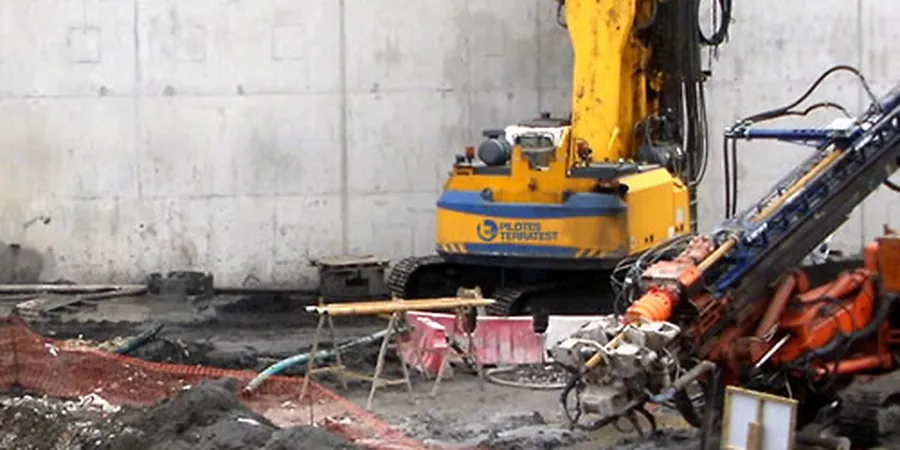
Murfreesboro sits at roughly 620 feet above sea level, directly atop the Ordovician limestone of the Central Basin. For contractors breaking ground here, the real challenge lies below the surface. The city's karst geology means voids, cavities, and unpredictable bedrock depths are common, especially in areas near the Stones River. A properly engineered injection program is the difference between a stable foundation and a future sinkhole. Our approach to grouting design integrates site-specific resistivity surveys to map subsurface anomalies before a single gallon of grout is pumped. The team then develops a targeted plan that accounts for Rutherford County's variable overburden and fractured rock conditions, something a generic specification from outside the region simply cannot address.
In Murfreesboro's karst, grouting design is not a commodity; it is a geological interpretation exercise that determines where every gallon of grout goes and why.
Scope of work
On a Murfreesboro site, the grouting operation typically begins with a colloidal mixer plant capable of producing consistent, low-bleed cement-bentonite slurries at high volumes. For compaction grouting in loose alluvial soils near the floodplain of the West Fork, we specify low-mobility aggregate grouts injected through cased boreholes at controlled pressures. When the target is fissure filling in the underlying Lebanon Limestone, our design shifts to permeation grouting with microfine cements or chemical solutions, verified by real-time monitoring of pressure, volume, and flow rate. These parameters are adjusted on the fly based on the fractured rock conditions documented during the
spt-drilling phase. Every injection hole is logged, and the grout takes are mapped against the detailed stratigraphy to ensure complete treatment. This level of control is critical because many Murfreesboro structures, from the MTSU campus expansions to new medical office buildings, must meet IBC Chapter 18 requirements for bearing stratum improvement. In areas where deep solution channels are identified, we often sequence the work with a preliminary
stone-columns installation to stabilize the overlying soil prior to high-pressure grouting.
Area-specific notes
A common error in Middle Tennessee is treating a grouting program as a simple material pumping exercise without adequate pre-injection investigation. When crews ignore the city's irregular bedrock profile and inject grout at a fixed pressure across the entire site, the result is often surface heave in the shallow soil zones and untreated voids deeper down. In Murfreesboro, where the top of rock can vary by 15 feet or more between two borings, this mistake leads to differential settlement and cracked slabs within the first year of operation. A design based on proper geotechnical characterization prevents these failures by defining refusal criteria, stage lengths, and maximum injection volumes per hole, ensuring the grout goes where the void actually is, not just where it is easiest to pump.
Q&A
How much does a grouting design and injection program cost in Murfreesboro?
For a typical residential or light commercial project in Murfreesboro, a complete grouting design and supervised injection program ranges from US$1,110 to US$4,020, depending on the depth to competent rock and the volume of voids encountered. Large commercial or industrial sites with extensive karst features will exceed this range. The final cost is driven by the number of injection points, the type of grout specified, and the required verification testing.
Is grouting always required for new construction in Murfreesboro?
Not always, but it is frequently recommended. If a geotechnical investigation reveals significant voids, loose soils, or a highly irregular bedrock surface in the Lebanon Limestone, the building official will typically require a grouting plan as a condition of permit approval under IBC Chapter 18. For smaller structures on competent, shallow rock, it may not be necessary.
What type of grout is best for Murfreesboro's limestone voids?
For large solution cavities, a low-mobility compaction grout with a sand-cement mix is most effective for displacing soft infill and filling the void. For tighter fissures and fracture zones, a high-mobility permeation grout using microfine cement or chemical grout provides better penetration. The design specifies the appropriate material and mix design based on the results of the pre-injection investigation.