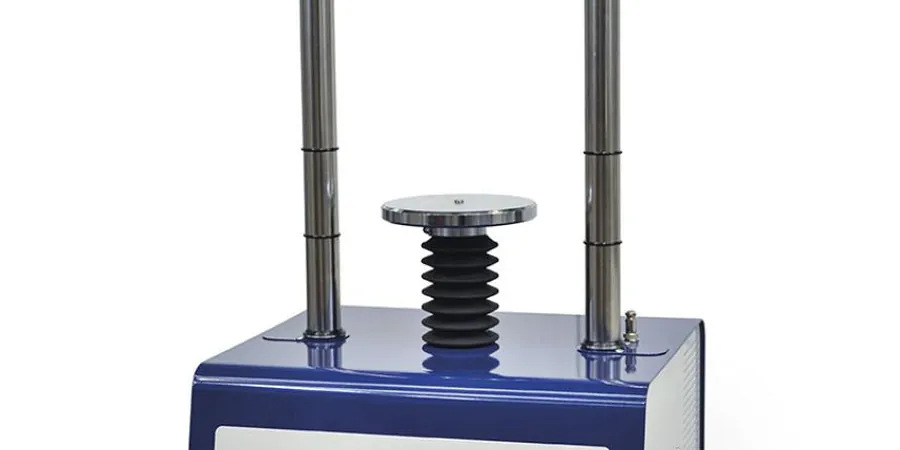
ASTM D4767 and D7181 define the standard procedures for consolidated-undrained and consolidated-drained triaxial compression tests on cohesive soils. In Murfreesboro, where the geology transitions from Ordovician limestone of the Stones River Group to deep clay residuum and alluvial terraces, shear strength parameters cannot be assumed from regional tables alone. The city sits at 619 feet elevation with a humid subtropical climate that keeps near-surface moisture content high for much of the year. A triaxial test on an undisturbed Shelby tube sample from a Murfreesboro site quantifies effective stress friction angle and cohesion intercept under controlled drainage conditions. The laboratory operates under ISO/IEC 17025 accreditation and follows ASTM D4767-11 for CU testing with pore pressure measurement. For projects near the West Fork Stones River or on the expansive clay slopes west of town, we often pair triaxial results with atterberg limits to characterize plasticity and with slope stability analysis when cuts exceed 12 feet.
Effective friction angles in Murfreesboro residual clay typically range from 24 to 32 degrees, but pore pressure response during undrained shear can reduce the operative strength by half.
Scope of work
A recent investigation for a medical office building off Medical Center Parkway involved stiff brown clay with occasional limestone fragments at 14 feet depth. The geotechnical engineer specified three CU triaxial tests at confining pressures of 15, 30, and 60 psi to define the Mohr-Coulomb failure envelope. Specimens were trimmed to 2.8-inch diameter, saturated via backpressure until a B-value of 0.96 was achieved, then consolidated isotropically before shearing at 0.002 inches per minute. The resulting effective stress parameters were c'=180 psf and φ'=28 degrees, values that controlled the footing width calculations under ASCE 7-22 load combinations.
For a warehouse slab-on-grade in the Gateway area, a drained test at lower confining stress confirmed a friction angle sufficient to eliminate the need for deep foundations. In granular soils encountered near the river, we recommend
spt drilling to recover split-spoon samples for index correlation, and
cpt test where continuous tip resistance profiles help interpolate between triaxial data points across the site. Every Murfreesboro project benefits from site-specific triaxial data because the residual clay can vary from lean to fat within a single boring.
Q&A
When does a Murfreesboro project need a triaxial test instead of just SPT correlations?
Triaxial testing is specified when the foundation design requires accurate shear strength parameters for settlement and bearing capacity analysis on cohesive soil. If the project involves deep excavations, slopes over 10 feet, or structures with high column loads on the stiff clay residuum common in Murfreesboro, SPT-based correlations from ASTM D1586 do not provide the effective stress friction angle and cohesion intercept needed for numerical modeling or limit equilibrium analysis.
How long does a triaxial test program take for a Murfreesboro project?
A standard three-stage CU triaxial test with backpressure saturation requires 7 to 10 calendar days from sample extrusion to final report. Consolidated-drained tests take longer, typically 14 to 21 days, because the shear rate must be slow enough to prevent excess pore pressure buildup. We provide preliminary parameters within 5 business days when scheduling is critical for the contractor.
What sample disturbance criteria do you use for Murfreesboro clay?
We evaluate sample disturbance using the change in void ratio during reconsolidation per Andresen and Kolstad (1979). Specimens exhibiting a volumetric strain greater than 4 percent during reconsolidation to the estimated in-situ stress may be flagged for interpretation caution. We recommend Shelby tube sampling with a sharp cutting edge and no reuse of damaged tubes when drilling the stiff residual clay of the Stones River formation.
What does a triaxial test program cost for a typical Murfreesboro commercial building site?
A triaxial test program with three CU specimens and a complete engineering report ranges from US$1,700 to US$2,740 depending on the number of confining stress stages and whether drained tests are included. The final cost depends on sample depth, required saturation time, and reporting detail.